

1st and 2nd Cycles
A difficult choice for parents.

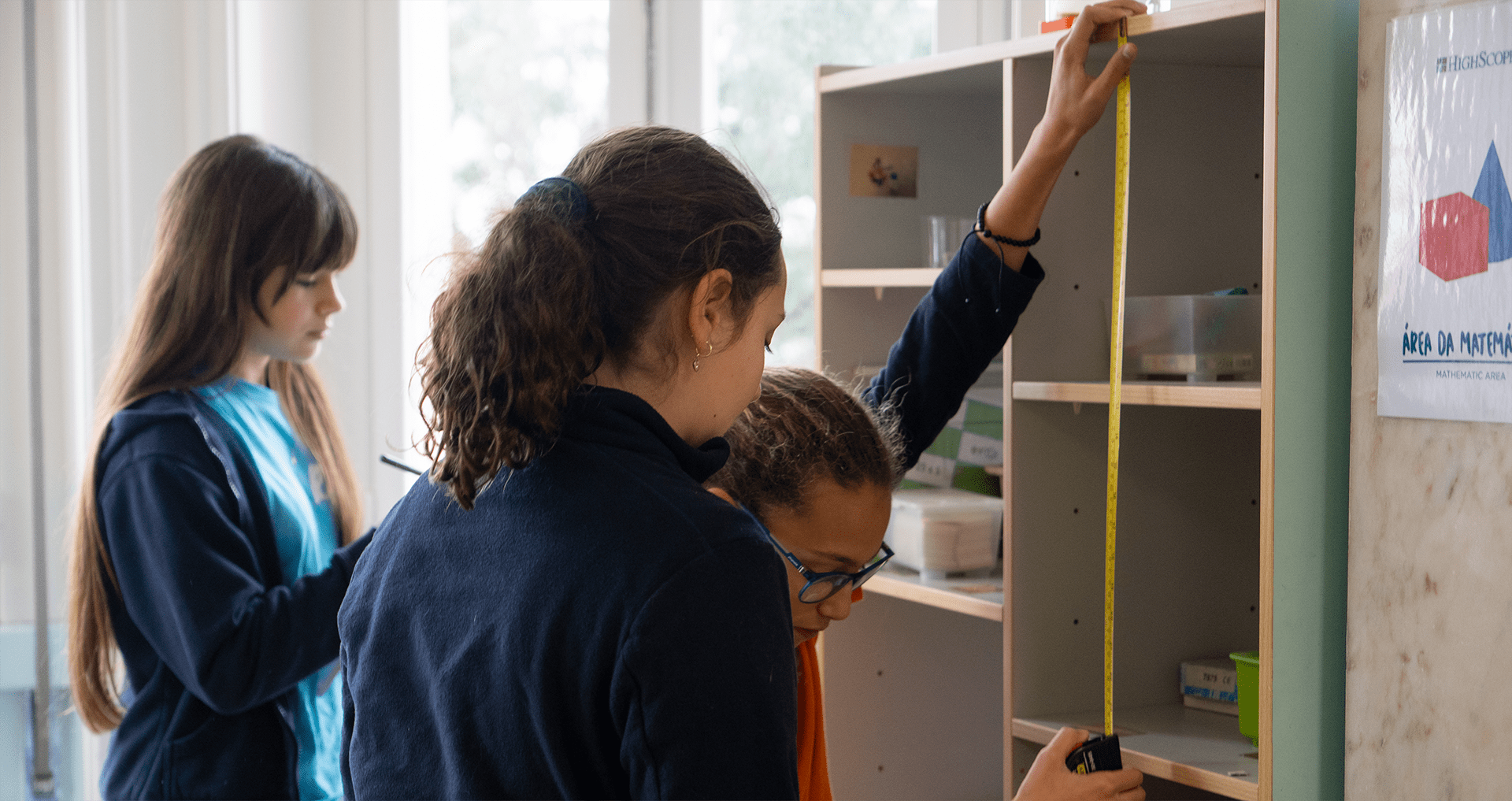
The student needs to engage in the process: act, read, re-read, discuss, find solutions to the challenges posed, consolidate and systematize knowledge— and through all this, truly know!
The process of interaction with the materials is supported by the teacher, in groups and individually. Thus, students discuss their subjects with classmates, express their opinion, and listen to others’ opinions, in small or large groups, according to their need and desire. Little by little, they are prepared to reflect on what they have learned, to realize what they need to study and to better understand the topics. And they are motivated to complete the cycle of the active learning process.
Some fundamental pillars for the teacher as they plan activities based on their students’ observation records:

This is where the process of metacognition begins. The student knows the content, because they have already worked on it hands-on and are now prepared to talk about it, reflecting on the learning process they have done. The main characteristic of a fruitful and knowledge-promoting discussion is knowing how to listen. And this implies being attentive to what the other person says, following their reasoning, and taking the most important points to incorporate into one’s thoughts. The student learns to respond to their classmates with a technique called “sandwich:” they start by highlighting 1 or 2 more positive elements about what their classmate said or did, add points to be improved, and end by highlighting something about what was said or done that is fundamental to them. They learn to summarize what they want to say, and they can say more and better in less time.

Students help each other, cooperate, realize the importance of others in this process, value their classmates, and value themselves.

Students make their individual productions and reflections. Having time to work in groups and discuss the subject with their classmates, leads them to feel the need for individual work, carried out with immense quality and motivation.

At the end of each activity, the group evaluates the work done, the achievements, and the points to improve. Errors are part of the process of evolution and are discussed and worked on, as well as the points already achieved and the new challenges launched. It is essential that the student is not afraid of not knowing, having doubts, and asking questions. The teacher supports these moments of group assessment and models positive behavior of differentiation. When the student feels valued by the group and the teacher, they find it easy to take risks and be creative because they trust themselves and others.

At the time of assessment, the student is secure, confident, and sure of what they know and how to demonstrate it. This is not the final step in learning, but it is an inherent step in the process and a facilitator of future learning. This assessment is carried out at various times throughout the week, in work presented orally and in writing and is complemented by formal assessment moments. It is a demanding, challenging, and personality-structuring process.
We give visibility to students’ work and the construction process – there’s nothing better to value the student than to have the possibility to give visibility to the work they have chosen and to explain what they have done and how they have done it. This is a process that happens with classmates and the community.
Students participate in public conferences, share how they learn, witness what it is like to be a HighScope child, and calmly answer questions from adults.
BRAIN BREAKS
Movement increases brain function. We use small physical activities to oxygenate the brain and body, facilitating the process of concentration, comprehension, memorization, and interpretation of the information worked on.
Brain breaks are either used to relax after a moment of recreation or to energize in the middle of a class or at the end of the day.
Teachers and students use our activity guide to facilitate the diversity of proposed activities, ensuring these moments are documented and remembered. We employ time markers and conduct regular training sessions to continuously update our strategies.
Time
The student’s time is organized in blocks of 1h and 1h30, divided into smaller times with various activities, according to their concentration level.
Hands-on activities always involve time exploring the material, understanding the concept or technique, discussion, and individual work. This is carried out in multiple ways in the 1st cycle classrooms, where the best way to understand this concept – drastically different from the transmissive teaching classrooms – is to visit Raiz.
Stations
“All roads lead to Rome,” if so, why do schools insist on using only one road?
When the teacher carries out Stations, they propose a set of 2 to 4 different activities to the students, where each activity occurs in a different space of the classroom. All of them are based on the same content with different and complementary hands-on activities. The student carries out all the activities, discusses proposed challenges with their classmates, carries out the protocols and, at the end, individually fills in a consolidation sheet. This whole process is supported by the teacher. Students are involved and focused, thus facilitating the differentiated support work carried out by the teacher throughout this time.
All teachers receive specific training to know how to implement this technique and are regularly supervised on it.
Plan-Do-Review
Central piece in the active learning process!
In this sequence, the child, with the support of the adult, plans what they are going to do, works to implement that plan, and then reviews in detail what they have done. Throughout this process, the teacher supports the student, who makes choices and is responsible for the decisions they make.
Students learn to be resilient, to deal with problems, to overcome obstacles, and to see them as part of the process and as learning opportunities. They share with their peers the falls they’ve taken and how they got up. When they need it, they know how to ask for help, and see it as an opportunity to strengthen interaction bridges with others.
Students thus gain an unbridled will to win that allows them to go very far in the present and in the future.
- Never get discouraged if you fail. Learn from it. Keep trying.
- Learn with both your head and hands.
- Not everything of value in life comes from books – experience the world.
- Never stop learning. Read the entire panorama of literature.
Thomas Edison
PBL
PBL – Problem-based-learning /project-based-learning/phenomenon-based learning
It is based on students’ active work, individually or in groups, in which they use the knowledge already acquired and develop new knowledge to solve a problem, develop a project, or better understand a salient situation.
Imagine that your topic is Pombal’s Downtown, and the goal is to understand what happened before and after its construction. There are those who study History listening to the teacher for 90 minutes while sitting on a chair, but there are also those who go to the place, read articles, look for information in manuals and books, talk to others, make models, reflect and Ah-ha, forever know the impact that the 1755 earthquake had in Portugal’s History.
In an integrated and in-depth way, the student studies earthquakes, tsunamis, reconstruction, and implementation on the ground, the impact of the physical world on the country’s history, and values such as solidarity and leadership. With specific knowledge and preparation, the teacher stands by the student, supporting them to reach further, to make other connections, and to be creative and critical in this learning process.
When learning becomes more practical, the time used to study theory has a stronger impact and a sweeter taste.
If this sounds like a dream to you, know that this is the reality experienced at Raiz International Active Learning School.
