Preschool

Preschool

The choice of preschool is difficult for parents.

This is a fascinating age of discovery, of becoming aware of the wonderful world that surrounds the child.
pre_img_1

The choice of preschool is difficult for parents. For the first time, they must choose who to hand their child over to during the working day and who to entrust with their cognitive, emotional, physical, and creative development. This is where our work begins: ensuring your child’s well-being in a healthy, positive, and learning-promoting emotional environment.

This is Raiz’s main purpose as the only Certified HighScope Center in Portugal. This certification attests to the excellence of the work we do here and, of course, the certainty that your child is integrated in a teaching approach tested over 50 years and under the care of a pedagogical team with certified training.

But sharing what the child ate or how they slept is only a small part of the work done with parents. At Raiz, parents are effectively involved in their children’s day, and are accompanied by a high-level educational team of professionals who support and advise them, step by step, according to each family’s needs and availability.

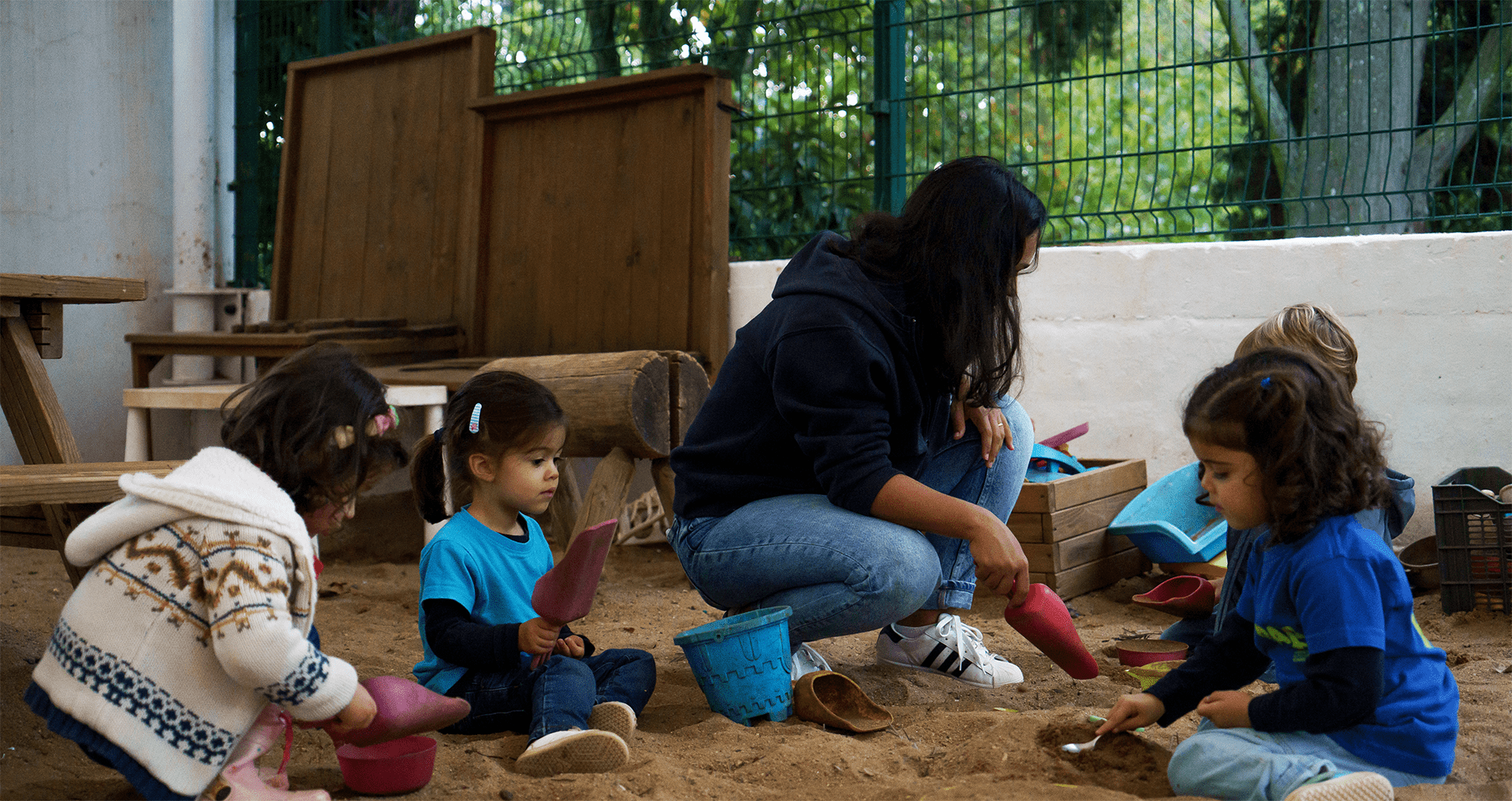
Here, the child establishes multiple interactions, creates closer relationships with peers and adults, begins to understand risks, challenges, and emotions. Energy is a constant and an excellent ally of Active Learning, in a very green environment, surrounded by trees, birds and squirrels.

  • Parents' Meeting

    Throughout the year, there are regular Parent Meetings for each group, which take place in a relaxed and informal setting. These meetings are short, take place first thing in the morning and parents soon learn about the discoveries, explorations, and challenges the group has been making. Parents’ Meetings are fantastic moments of sharing and interaction between parents and education specialists.

  • Active Learning

    The child gets involved, makes intentional choices, sets their imagination free, questions, relates and develops thinking. Creativity happens, mathematical reasoning takes on another dimension, and the taste for literacy, language, and communication becomes visible.

    The 5 ingredients of active learning are at the basis of all Plan-Do-Read activities, Small Group times, and Large Group time.

  • Intentional Teacher

    The educator and the assistant implement the HighScope model with quality, they put intentionality in what they do, and act with a carefully outlined goal.

    The intentional teacher carefully manages the emotional climate, recognizing its critical role in child development, and creates a positive environment that focuses on the child’s capabilities and ability to solve problems and challenges. They intentionally choose the contents to be introduced and the moments in which to do so and observe how each child reacts. They give individual support to each child at their current level and the progress they need to make. They use specific observation and analysis tools validated by HighScope. They share the achievements and progress made with parents so, together, they can combine strategies for the next challenges.

    The teaching-learning process becomes truly fascinating for everyone.

  • The detail

    Each child is unique and at this age the ability to share with parents is already possible. We have therefore created strategies and tools to facilitate this sharing process. We don’t want parents to stay at the door or hand their children over in the car; we want to be with you and share the fascination of learning with you in 10 minutes. We know that parents have very intense lives and schedules to keep, so we have created several strategies to help you keep your pace and prevent this wonderful phase of your child’s life from slipping away.

    Time flies, and from experience, we’ve learned how to make the most of every moment. Our team is here to guide you.

    If you are feeling insecure, call. If you have left your child and need to confirm that they are okay, don’t hesitate to call because within a few minutes a member of our staff will go to the respective room to collect information for you. We need parents to be confident so that children can be confident too, and we know how difficult the beginning of this separation is.

    A team of experienced psychologists ensures that whatever challenging phase you may be going through due to personal, family, or health issues, you have the support you need, without having to go elsewhere. You can make an appointment for the same week if you wish.

  • Teaching-Learning

    The teaching-learning process happens “hands on.” The child’s day is carefully designed by HighScope, with a daily and complete routine that ensures harmonious work in response to the child’s needs.

    There are 8 areas of learning, thinking, and reasoning on which the preschool curriculum is developed.

    INITIATIVE

    The child develops the ability to take initiative and solve problems that arise while playing. Physics, Mathematics, Literacy, and Art are integrated into any play and the child learns very complex concepts in a playful way. Learning becomes consistent because it is not done through worksheets, but through real challenges and detailed activities planned by the educator and assistant, with a pedagogical goal in mind. The child takes pleasure in understanding the world, processing information, and gaining knowledge.

    The love of learning is developed at this age, there can be no gap between playing and learning, because it is possible and effective to LEARN BY PLAYING.

    SOCIAL AND EMOTIONAL DEVELOPMENT

    The child develops a positive sense of self, has high self-esteem, believes in their abilities, and feels the strength and will to go further. They know they are capable and know that making mistakes is part of the journey. The child recognizes, names, and talks about what they are feeling. Expressing feelings makes life clearer and decisions easier. The child establishes strong relationships with peers and adults and participates in group activities, developing community spirit. Cooperative play makes them feel part of a group and realize the importance of others in our lives and how to establish healthy relationships.

    Educators and assistants are specifically trained in the 6-step technique for solving conflicts. They share with parents how they can do this at home as well. When conflict arises, it is seen as an opportunity to develop personal and social skills.

    PHYSICAL AND MOTOR DEVELOPMENT

    The child lives in nature and is part of it, carries out activities inside and outside the building. They maintain a close relationship with the neighborhood and the surrounding space since the latter provides it. In the midst of the green of the trees, the calm of the river, and the chirping of birds, physical and psychological balance become easily achievable.

    There is a daily time in children’s routine specifically for music and movement and every week the children have, in addition to this daily time, Physical Education with a specialized teacher.

    LANGUAGE, LITERACY AND COMMUNICATION

    A very strong area of the HighScope model. The child expresses their ideas and thoughts, the teacher and the assistant have time to listen and talk to them. Literacy is taken very seriously, and the child gains a taste for reading, listening to reading, and writing that only those who experience it can testify to it.

    Books, stories, and role-play play a key role here. The child develops vocabulary, phonological and alphabetical knowledge, and learns to read and write in a sustained, natural, and motivating way.

    The child learns Portuguese and English throughout the day with Portuguese-speaking and English-speaking educators, teachers, and assistants. The child learns to express themselves in both languages, which comes naturally as they are organically exposed to both languages in the classroom. Raiz has students with Portuguese native language and others with English native language and both are embedded in them. We thus enable all students to develop both languages at their own pace.

    MATH

    The world of mathematics appears as intensely as the child’s energy. Numbers, symbols, counting, mental calculation, shapes, measures, dimensions, units, patterns, and data analysis, all these concepts arise naturally in the educational proposals of adults. Children are supported in exploring and acquiring each of these concepts through active learning. Parents are fascinated when they realize that their three-year-old child already has a mathematical thinking and language that would make many older children envious. There is no yellow, 5, or triangle day; learning is contextualized and carried out with the child’s stage of development.

    CREATIVE ARTS

    Expressing oneself through art is much more than drawing a house with 2 windows and 1 door. Children express and represent what they observe, think, imagine, and feel in two and three dimensions. Music is part of the daily activities carried out and appears in the child’s day in different ways. Dramatization has a very significant expression at this age and the child performs dramatizations with various purposes in mind. Works of art, landscapes, and the world appear in the child’s life and the child learns to appreciate them with detail and critical thinking.

    SCIENCE AND TECHNOLOGY

    An essential dimension for the development of the analysis process children will need years later. Knowing how to observe with a specific strategy and technique, classifying, experimenting, predicting, drawing conclusions, and communicating ideas are fundamental steps in scientific thinking, which are developed at Raiz from the age of 3. The child uses technology and its instruments in the research process they carry out.

    SOCIAL STUDIES

    At this stage, the child is awakening to the world; curiosity and the desire to know are natural and the educational team takes advantage of this desire to expose and reflect naturally on the diversity of cultures, interests, and abilities. They learn to see diversity as an added value for all and to accept others as they are. They develop a sense of community, rules, values, and respect for each other’s diverse beliefs. They study aspects of History, Geography, and Ecology.

Want to know more?